


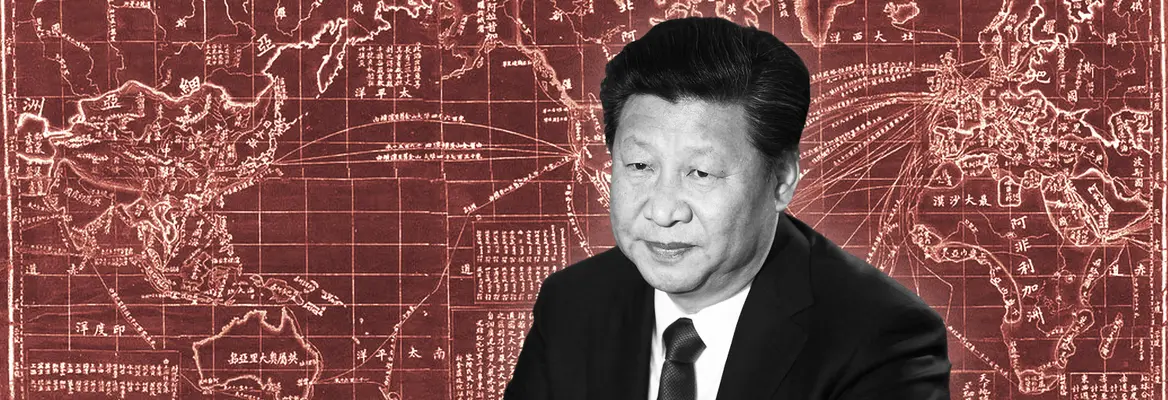

President Xi Jinping has repeatedly said China will "never seek hegemony, expansion, or a sphere of influence." Nonetheless, Western academics like John Mearsheimer continue to argue China will seek to become a regional hegemon. Chinese International Relations Professor Astrid Nordin argues that in fact, both are true. When China says it rejects hegemony, it means the illegitimate form of bullying and coercive power it associates with the US. It’s not rejecting a hierarchical world order with China at the top, moral and competent, rewarding those who follow, and disciplining those who don’t.
When Chinese President Xi Jinping met US President Donald Trump on his visit to the US last week, he spoke of the two countries’ historic responsibility for human progress and their shared responsibility for addressing global challenges. Few familiar with China will have been surprised by this rhetoric, which drew on his longstanding insistence that “no matter how developed it could become, China will never seek hegemony or engage in expansion.”
Xi’s repeated assertions that China will never seek hegemony push back against the longstanding proposition in much Anglophone academic and political debate that China is bound to do exactly that: seek to replace the US as global, or at least regional, hegemon. One doesn’t have to look far to find explicit remarks to this effect. Academic superstar John Mearsheimer’s “offensive realism” famously dictates that “China is likely to imitate the US and attempt to become a regional hegemon,” out of structural necessity. Former Biden-official-cum-scholar Rush Doshi has drawn on Chinese strategic rhetoric to make a similar argument: If there are two paths to hegemony—a regional one and a global one—China is now pursuing both.
There appear, then, to be two directly contradictory claims in circulation. China will seek hegemony. China will never seek hegemony. Which claim is right? A closer look at the understandings of hegemony on which these interlocutors draw suggests a different question: when Xi rejects hegemony, is he necessarily rejecting the kind of international position that scholars like Doshi and Mearsheimer call hegemonic?
What does it mean to reject hegemony?
To Mearsheimer and his “defensive realist” followers, hegemony means domination of a regional or global system through overwhelming relative power. To Doshi, it denotes a hierarchical order in which the pre-eminent state secures others’ deference through some combination of coercion, inducement, and legitimacy. If to “never seek hegemony” means never seeking to be significantly more powerful than your neighbors, or never seeking others’ deference, Xi’s statement would be an extraordinarily restrictive promise. However, neither official PRC rhetoric nor important Chinese theories of international order necessarily understand anti-hegemony that way.
In Chinese political rhetoric, hegemony is commonly rendered as baquan (霸权), and hegemonism as baquan zhuyi (霸权主义), a term with deep Maoist roots that generally identifies an illegitimate form of bullying and coercive power. It is often used to describe US hegemony specifically, and contrasted with a Chinese and more harmonious form of leadership. The upshot is that a Chinese statement that “China will never seek hegemony” is not necessarily a statement that China will never seek to build a hierarchical order with itself at the top, or to induce others’ deference with both carrots and sticks. It may instead be saying that China will never pursue pre-eminence in ways that it considers unnecessarily aggressive or despotic. This is not simply a question of semantics or mistranslation. The question is not whether China seeks superior power, but what kinds of power it considers legitimate, and on whose behalf.
___
Want to continue reading?
Get unlimited access to insights from the world's leading thinkers.
Browse our subscription plans and subscribe to read more.
Already a subscriber? Log in
Love the iai?
Sign up to get exclusive access.

Related Posts:




Related Videos:




2nd October 2026



Join the conversation