


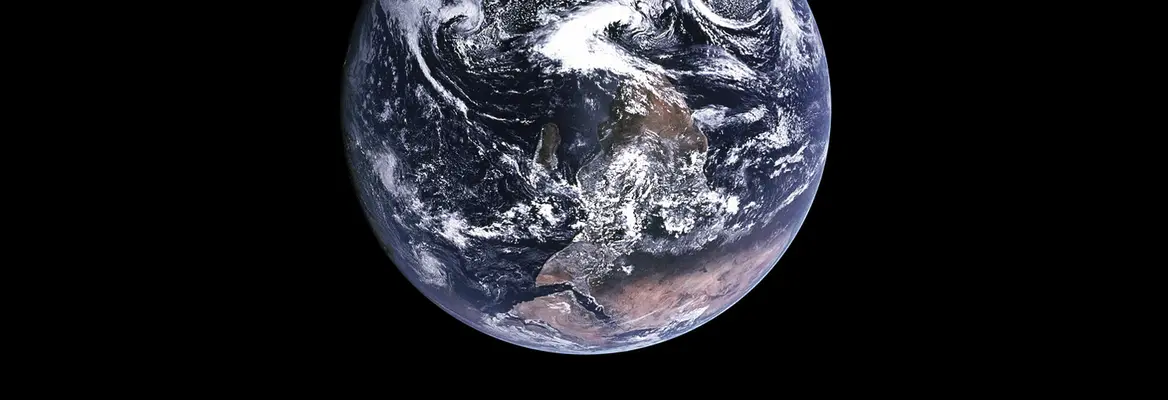

The famous image of Earth from space looks neutral—but it was quietly turned to put the north on top. Professor Elleke Boehmer argues that this small adjustment captures a much larger habit of mind, and that there is no objective perspective by which to view the world. By reading literature from the far southern hemisphere, we can flip our planetary perspective, loosen the grip of northern dominance, and learn to see the world as a more connected, fragile whole.
The “blue marble” photograph of Earth taken in 1972 from Apollo 17 is one of the most famous photographs of the twentieth century. At first glance, it is as neutral an image of our planetary home as we can imagine—the green and blue orb floating in dark space. This is why it has served as an emblem for a variety of environmental movements, a neat image of our place in the universe, the only one we have.
But now, let us look more closely. Most reproductions show the globe with the North Pole “at the top,” with white cloud curdling up over Africa below. From its very first appearance, however, the photograph was inverted to conform to global conventions. In fact, Apollo 17’s camera had first pictured the planet as bearing the vast, white cap of Antarctica.
___
Reading forms an especially potent resource for moving away from embedded philosophical standpoints, and, in this case, opens windows to look at the earth from other angles, including from the south.
___
From then on, the reangling of the earthly blue marble has perfectly illustrated something important about how we look at the world. The general view is fixated on developments in the northern hemisphere. Events occurring across the great continental sweep that extends from Eurasia into North America are deemed to be more important than anything happening elsewhere. Globalization has been dominated by these regions. At the end of 2025, many media summaries of the first quarter of the twenty-first century featured not a single global event from south of the equator, not even a volcanic explosion or a tsunami, the southern disasters that sometimes make the news. Only around 11% of the world’s population lives in the southern hemisphere. Most of it is ocean. For decades, newspapers and media outlets have confidently assumed that nothing much of significance will happen in these regions.
But what if we decide not to revert to the northern default? My book Southern Imagining explores this question.
It reflects on the phenomenological difficulty of our ever seeing the world from an objective standpoint, limited as we are by our geopolitical perspective and our plain human subjectivity. But, if we allow for these constraints, we may also be able to map pathways towards an alternative point of view, one that will allow us to counterbalance and mutually assess different subjective standpoints, especially, in this case, on the planet. Such calibrated views may emerge from our discovering more about so-called marginalized cultures and their alternative frameworks of knowledge, and also by learning other languages. Reading forms an especially potent resource for moving away from embedded philosophical standpoints, and, in this case, opens windows to look at the earth from other angles, including from the south.
Want to continue reading?
Get unlimited access to insights from the world's leading thinkers.
Browse our subscription plans and subscribe to read more.
Already a subscriber? Log in
Love the iai?
Sign up to get exclusive access.

Related Posts:



Related Videos:




27th February 2026



Join the conversation