


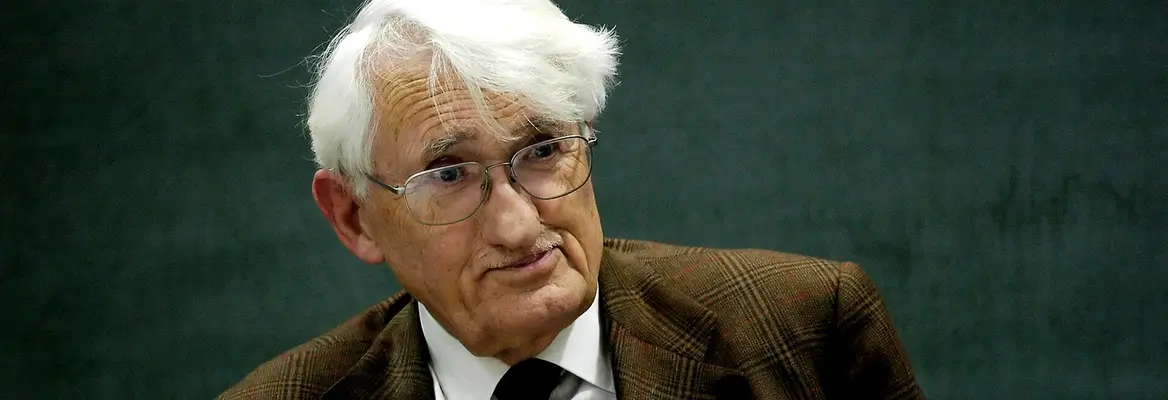

With the passing of philosopher Jürgen Habermas, we explore the enduring importance of his work on democracy, human rights, and the public sphere. Rainer Forst, Claudio Corradetti, and John S. Dryzek give their thoughts on Habermas and the legacy of his philosophical contributions - including his theory of communicative rationality, which laid bare both the power of ideas and the challenge of applying them in a complex and imperfect world.
The Public Use of Reason: On the Death of Jürgen Habermas
With the passing of Jürgen Habermas, who shaped the humanities and social sciences of our time as perhaps no other thinker has, we lose a unique and irreplaceable intellectual voice. I have lost a teacher and interlocutor to whom I owe more than I can express.
To take the measure of his work, we must look back to the great figures of philosophy. The most natural comparison is with Immanuel Kant, for Habermas remained committed throughout his life to the Kantian imperative of illuminating our conditions of existence through the “public use of reason” — that is, through discourse among those affected. This theme runs through all his writings, which forge a new connection between philosophy and the social sciences: emancipation through communicative reason, a form of reason that seeks to recognise and overcome its own socially produced constraints. Drawing on Hegel, Marx, Weber, and Critical Theory, he radicalised the Kantian project.
No one matched Habermas in bringing together theoretical critique and political practice, binding the critique of ideology to standards of reason. This demanded an unerring sense for the most pressing problems of the day, both intellectual and social, and it never allowed him to rest. I witnessed this first-hand in the mid-1980s, when I studied with him as he simultaneously challenged post-structuralist philosophy and helped ignite the so-called Historikerstreit. In the former, his aim was to defend critical rationality; in the latter, to resist a regression in Germany’s historical consciousness.
These remained his central concerns to the very end: a sometimes desperate, but never hopeless, effort to think through radical democracy in its fullest sense and to work toward its realisation. In this respect, his work remains unfinished, even as it stands as a monument. He will be greatly missed — as a thinker of extraordinary breadth, a passionate intellectual, and a remarkable human being.
Rainer Forst is Professor of Political Theory and Philosophy at the Goethe University Frankfurt am Main.
A Farewell to Jürgen Habermas
When Europe emerged from the devastation of war, little remained of its democratic ideals. Even where fascism was not openly endorsed, the continent was shaped by authoritarian and illiberal cultures. A new democratic grammar had yet to be learned. Jürgen Habermas devoted his life and work to supporting this cultural and political transformation. He developed a philosophical model in which communication depends on pragmatic-transcendental conditions — sincerity, truthfulness, and normative validity — that make coordinated action possible. At the same time, he defended a procedural conception of democracy, in which the formation of political will begins with dispersed, informal processes of opinion-formation before moving into institutional channels.
Want to continue reading?
Get unlimited access to insights from the world's leading thinkers.
Browse our subscription plans and subscribe to read more.
Already a subscriber? Log in
Love the iai?
Sign up to get exclusive access.

Related Posts:

Related Videos:

Claudio Corradetti
John S. Dryzek
19th March 2026


Join the conversation