




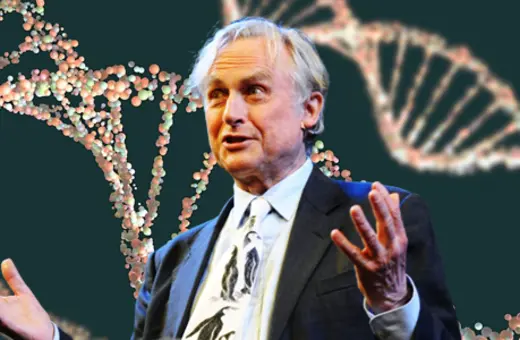
We often see evolutionary theory as the enemy of religion. But in Darwin’s day, many scientists thought otherwise. Neo-Darwinism, today championed by atheists like Richard Dawkins, was founded by a devout Christian, who explicitly tied its mechanistic vision of life to a world ordered by God’s laws. In contrast, argues Stanford historian of science Jessica Riskin, the anti-mechanistic theory of Lamarck—which grants living beings genuine creativity—was attacked as dangerously atheistic. Riskin argues that today’s supporters of neo-Darwinism have forgotten its theological roots, and that Lamarck’s theory, with its radical, anti-theological motivations, should be taken more seriously.
One of the longest-running debates in the history of science must surely be the one about whether living beings exert creative agency to influence the course of evolution. When whales adopt a new hunting technique, birds change their mating patterns, or lizards migrate to a colder altitude and find a way to warm themselves on the sunbaked rock, do they shape their descendants by these behaviors? Or are they subject to an evolutionary process over which they exert no influence? For a century and a half, this argument has raged. Neo-Darwinists have held the dominant position. According to them, animals are passive, the objects of random variation and natural selection. But revisionist challenges have multiplied in recent decades, pressing for a broader picture of evolution in which other factors, including animal behavior, come into play.
This long debate over the evolutionary agency of organisms grew out of an earlier one about whether evolution took place at all. The person who set off all this controversy was a Frenchman named Jean-Baptiste Lamarck. In 1802, Lamarck coined the word “biology”; and in 1809, the year of Charles Darwin’s birth, he published the first theory of evolution in his magnum opus, The Zoological Philosophy. In this work of audacious radicalism, Lamarck usurped God’s monopoly on Creation and reassigned it to mortal beings.
Life originated in spontaneous generation, Lamarck wrote, brought about by natural forces such as electricity and heat acting upon inanimate matter, causing the emergence of the simplest organisms: single-celled protozoa and algae. A property intrinsic to living matter then exerted itself, a tendency to complexify, which Lamarck named “the power of life.” This was a material force akin to those of contemporary physics: electricity, magnetism, gravity. As organisms grew more complex, another cause of transformation entered, according to Lamarck: responsiveness to the environment. In the simplest beings this responsiveness was rudimentary—an irritability or sensitivity and reflexive reaction—but birds and mammals were capable of “acts of will,” forming “habits” and “ways of life” in response to their circumstances. The giraffe somehow became the emblem of this idea, although Lamarck only wrote a couple paragraphs about giraffes in all his voluminous writings. He suggested that by stretching to reach high leaves, giraffes elongated their necks by infinitesimal amounts, then passed on these tiny changes, which accumulated over the generations to produce the giraffe’s long neck.
___
The more self-driven activity we recognize in the living world, the less it seems to require a supernatural source of order and meaning.
___
Want to continue reading?
Get unlimited access to insights from the world's leading thinkers.
Browse our subscription plans and subscribe to read more.
Already a subscriber? Log in
Love the iai?
Sign up to get exclusive access.

Related Posts:
Related Videos:
11th August 2026

Join the conversation