


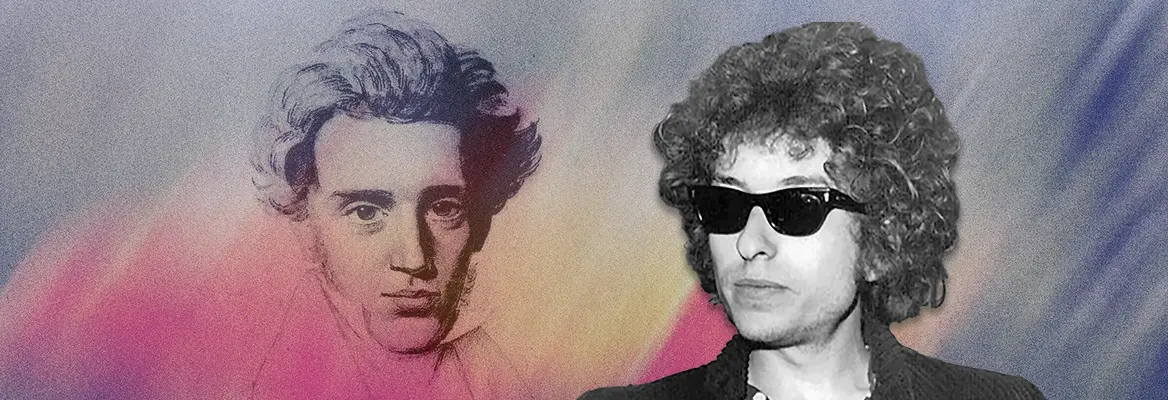

Søren Kierkegaard claimed that a self is not a static object, but something one must become, by struggling through distinct, often incompatible modes of existence. Author of Bob Dylan and the Spheres of Existence, Christopher Barnett, argues that this model of the self is the key to understanding Bob Dylan’s career. Critics often dismiss Dylan’s reinventions—from folk prophet to electric provocateur to born-again preacher—as masks concealing an elusive core, but Kierkegaard suggests the opposite. Rather than being an evasion of authentic identity, Dylan’s masks capture a self in the act of becoming.
A recurring motif in the 2019 documentary film Rolling Thunder Revue: A Bob Dylan Story by Martin Scorsese is that Bob Dylan is a trickster. In The Encyclopedia of Fantasy, John Clute and John Grant describe tricksters as shapeshifting figures who, whether in animal or human form, expose the instability of ordinary life. They may not be “good” in a conventional sense, but even in their untrustworthiness, they are capable of providing insight into a world that is itself insecure.
In Rolling Thunder Revue, Scorsese playfully appropriates Dylan’s reputation for manufacturing his own image. Famously, Dylan grew up in a middle-class Jewish family in Minnesota, moved to New York City, and fashioned himself as a hardscrabble folk singer. This may have been his first mask, but it was hardly his last. Over a decade later, on the Rolling Thunder Revue tour, Dylan performed onstage in white mime makeup, placing one mask over another. With this in mind, Scorsese incorporated several minutes of invented documentary footage into the film’s otherwise real-life narrative. Such a blurring of fact and fiction is, however, consistent with the trickster’s societal role. In one key scene, Dylan himself seems to validate this point: “We didn’t have enough masks on that tour,” he recounts, “we should’ve had masks for everybody. When somebody is wearing a mask, he’s gonna tell you the truth. When he’s not wearing a mask, it’s highly unlikely.”
Scorsese’s film, while clever, was by no means the first to advance this understanding of Dylan. Indeed, Dylan’s status as a Janus-faced trickster was developed in the 2007 film I’m Not There, in which different actors are used to represent different phases of Dylan’s career. According to director Todd Haynes, I’m Not There is an exploration of a crisis of meaning that Dylan represents in his life and in his art. On this reading, Dylan’s adoption of sundry personae—an indigent, weary folk musician here, a sleek pop star there—constitutes a rebellion against the notion of individual identity, which is “a straitjacket for people, for societies, for cultures, for historical moments.” Thus Dylan’s songs and his efforts in cinema, literature, and the visual arts do not serve a grand design or a higher purpose. Instead, they bear witness to the artist’s “healthy erraticality.” For Haynes, Dylan’s reinventions involve the death of one identity and the emergence of another: “Each of those transitions from character to character . . . is also a liberation into a new self, a new identity.”
In 2019, I began teaching a course at Villanova University called Bob Dylan and Theology. It was not at all difficult to find material for my students: there are biographies, literary studies, philosophical analyses, theological interpretations, and historical accounts. At this stage of his career, Dylan has become not merely a celebrated songwriter but a cultural institution. He received the National Medal of Arts in 2009 and the Nobel Prize in Literature in 2016. In May 2022, the Bob Dylan Center opened in Tulsa, Oklahoma, to preserve and extend his legacy.
Want to continue reading?
Get unlimited access to insights from the world's leading thinkers.
Browse our subscription plans and subscribe to read more.
Already a subscriber? Log in
Love the iai?
Sign up to get exclusive access.

Related Posts:


Related Videos:


14th September 2026


Join the conversation