


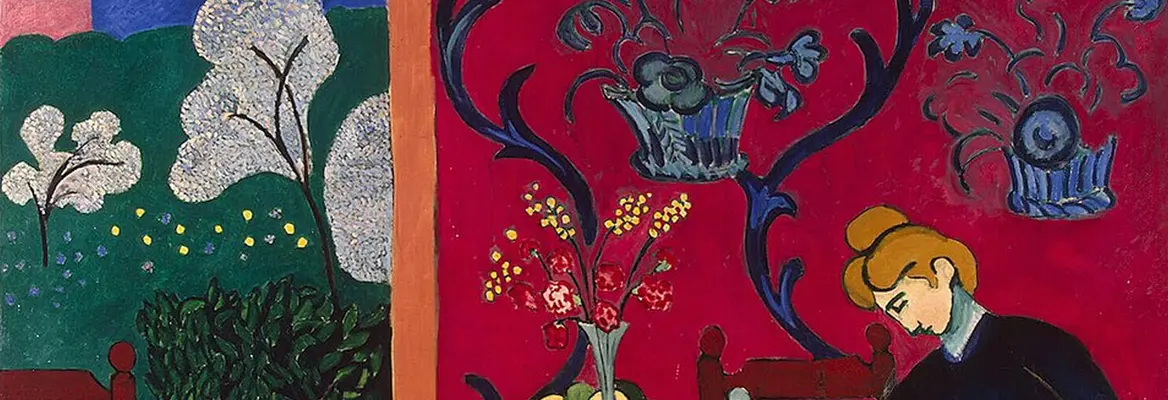

We tend to think of reality as being just one, singular way, glimpsed more or less accurately through perception. This is a mistake, argues South Korean philosopher and writer Alex Taek-Gwang Lee, drawing on Sartre’s philosophy of the imagination. Inspired by the radical innovations of the artist Henri Matisse, Sartre claimed that the imagination’s freedom to play with supposedly fixed metaphysical categories reveals reality’s total openness. There is no single way reality is, and so no rules governing how it must appear in consciousness. Imagination is where that liberating negative truth breaks through.
What does it mean to see the real through the unreal? This question lies at the centre of Jean-Paul Sartre’s theory of imagination, and it finds one of its most vivid artistic examples in the paintings of Henri Matisse. For Sartre, art is not simply a copy of the world. Nor is it a decorative object placed before the viewer for passive enjoyment. A painting is a material support for an act of consciousness. It enables us to move beyond what is immediately given and to enter the domain of possibility.
This is why Matisse matters for Sartre. In the intellectual landscape of twentieth-century Paris, the presence of Matisse’s Harmony in Red (The Red Studio) in Sartre’s philosophy takes on profound symbolic significance. The painting’s overwhelming red expanse embodies the radical break with convention that characterized both Fauvism and existentialism. Just as Sartre sought to liberate philosophical thinking from traditional metaphysical assumptions, Matisse liberated color from its subordinate role in pictorial representation. Fauvism, whose name derives from les fauves, the “wild beasts,” was therefore more than another artistic movement. It constituted a fundamental reconceptualization of how painting could create meaning. The hierarchy that subordinated color to form was overturned. In Matisse’s hands, color became the primary agent of pictorial organization, capable of creating spatial relationships and emotional resonances through its own internal logic.
This revolution is powerfully demonstrated in Matisse’s Window at Collioure (1905), a watershed moment in modern painting. Here, the traditional function of the window as a frame organizing perspective and delimiting space is transformed. Rather than using color to fill in a pre-established architectural structure, Matisse allows chromatic relationships themselves to generate the painting’s spatial organization. The window frame becomes not the boundary between interior and exterior, but one element in a unified field of color relations. The parallel with Sartre is striking. Just as Matisse freed color from its subordination to form and perspective, Sartre sought to liberate human consciousness from predetermined essences and metaphysical frameworks. In both cases, what had been considered secondary or derivative, i.e., color in painting, existence in philosophy, is revealed as primary and constitutive. The overwhelming red of The Red Studio creates a pictorial space that resonates with Sartre’s insistence on the primacy of existence over essence.
Traditional Western painting had generally treated color as secondary to drawing and composition, a prejudice that reflected deeper assumptions about form and matter, essence and accident. While Impressionism and Pointillism still remained tied to natural phenomena, the Fauves enacted a more radical break. They transformed color from a tool of representation into a direct vehicle for emotional expression. Their spontaneity was not instinct but “considered immediacy,” an approach that condensed affect into coherent pictorial form. Matisse’s “emotional perspective” captures this perfectly: a way of organizing space not according to optical rules but according to affective relationships.
Want to continue reading?
Get unlimited access to insights from the world's leading thinkers.
Browse our subscription plans and subscribe to read more.
Already a subscriber? Log in
Love the iai?
Sign up to get exclusive access.



22nd September 2026

Join the conversation
Larry Greer 24 September 2026
I wonder to what degree Alex's framework for talking about the doors a piece like The Red Room offers for venturing into the "unreal" beyond The Red Room closes some of those doors. And I think objects of art are no less a part of the "real world" than anything else is.