


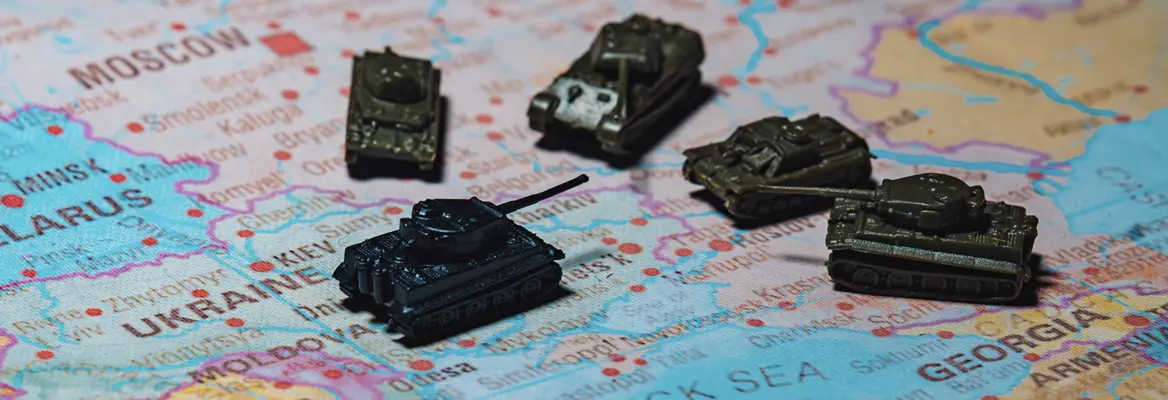

As conflicts between great powers come to a head across the Middle East and Europe, it seems inevitable that smaller states will find themselves caught up as collateral damage. But political scientist Kristi Raik argues small states are more resilient than we give them credit for. From Ukraine to Finland and the Baltics, she shows how times of rupture reveal small states not as victims, but as strategic actors capable of shaping their own survival – and what this means for the international order now taking shape.
When the Baltic states declared independence during the final year of World War I, few world leaders believed they would survive as sovereign nations. The UK provided critical support to Estonia in the early days of independence, including the shipment of twenty cannons, approximately seven hundred machine guns, twenty-six thousand five hundred rifles, thirty-one thousand cannon shells, thirty million bullets, vehicles, telephones, coal, oil, petrol and five hundred and fifty tons of wheat, to help the meagre Estonian army stem the spread of communism. But the larger goal of British involvement was to support the counter-revolutionary White forces of Russia, who were just as keen as the Bolsheviks to keep the Baltic countries under Russian rule.
In the case of Finland, Lenin endorsed the country’s independence, declared on December 6th 1917, in the expectation that it was a temporary phenomenon. He assumed it would soon be overridden by the broadening of the Bolshevik revolution that would return the country under the control of Russians: now Red instead of White. (Later, though, the Finns used Lenin’s support to their independence as an argument to push back relentless Soviet efforts to constrain their sovereignty.) The Finns themselves had concerns about the viability of their newly established independence, which they tried to alleviate by inviting a German king to rule the country—a plan that soon faced a humiliating collapse with Germany’s defeat in World War I.
___
Small states cannot take their existence for granted and are often willing to take risks in order to make any attempt to subjugate them prohibitively costly for larger powers.
___
During World War II, Finland allied with Nazi Germany to push back the Soviet invasion, while the Baltic states were occupied first by the Soviets in 1940, then by the Germans from 1941 to 1944, followed by Soviet occupation from 1944 to 1991. Tony Judt describes in Post-War how the Baltic states remained “only half-digested” by the Soviet system, open to “foreign influence and example”, and were quick to seize the opportunity to reclaim their sovereignty when Moscow’s grip loosened.
These examples illustrate how, at each major rupture of European and global order in the twentieth century—the two world wars and the end of the Cold War—the fate of many smaller nations became the object of great-power competition. Yet the outcomes of these contests cannot be explained solely by the will of great powers, or by the structural conditions that shaped a new balance of power between them. Rather, Europe’s modern history shows that the agency of smaller nations during times of international upheaval is crucial for their own destiny, while also shaping the new order that emerges from the ruins of the old.
Want to continue reading?
Get unlimited access to insights from the world's leading thinkers.
Browse our subscription plans and subscribe to read more.
Already a subscriber? Log in
Love the iai?
Sign up to get exclusive access.

Related Posts:


Related Videos:

12th March 2026



Join the conversation