


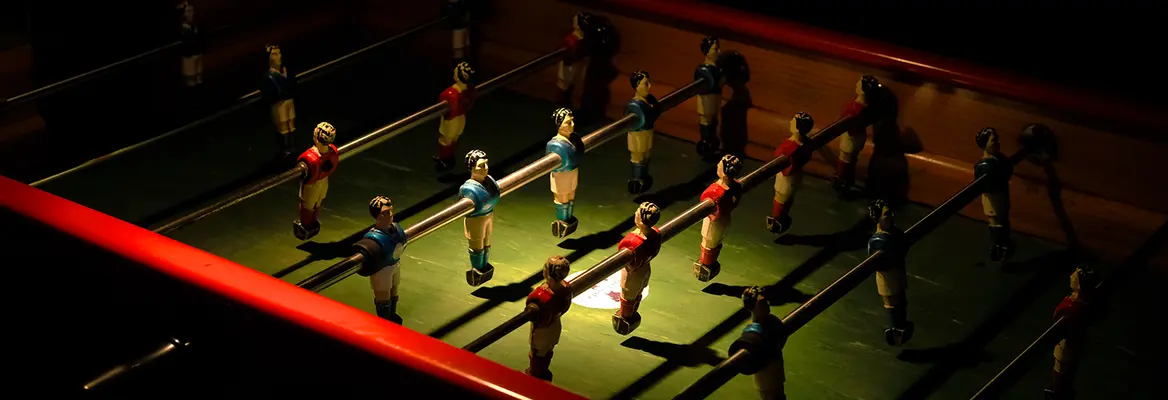

From ancient Greece to Nazi Germany, sport and politics have long been intertwined. Nevertheless, we still imagine that international sport can be kept above the fray and serve as a neutral arena where nations compete on merit alone. In this article, diplomacy scholar Geoffrey Allen Pigman argues the 2026 FIFA World Cup shows this is a dangerous illusion. When international sport is left entirely to revenue-maximizing private bodies like FIFA, it doesn't escape politics, but rather surrenders to its worst expressions. With the 2028 Los Angeles Olympics fast approaching, the IOC must decide whether to learn that lesson or repeat the same mistakes.
The largest and most lucrative FIFA World Cup ever draws toward its climactic conclusion amidst a swirl of controversy. Team members, staff, fans, and spectators have been denied their right to enter the United States to participate, and US President Donald Trump intervened with FIFA boss Gianni Infantino to overturn a referee’s call that Trump believed disadvantaged the US national team. It is a moment to step back and reflect on what the purposes of international sport mega-events like the World Cup, and international sport more broadly, are, and what they should be. Does international sport serve public purposes? Is there a public interest? Or is it primarily a private endeavor organized by commercial enterprises to entertain the global public (and generate profit in the process), which is occasionally used by governments and leaders for raisons d’etat?
Central to the idea of sport is the principle of fair play, which in the international context demands that games be free from political interference. However, it is impossible to separate sport from politics, all claims to the contrary notwithstanding. The most positive political use of international sport through the millennia has been to facilitate diplomacy. The use of international sport for diplomatic objectives has existed since at least the time of the ancient Olympic Games, around which was instituted the custom of the Ekecheiria, or Olympic Truce, between participating states to facilitate fair competition and diplomatic achievements by ensuring that participants could travel safely to the Olympiad.
In his seminal work On Diplomacy (1987), diplomacy scholar James Der Derian characterized the objectives of diplomacy as overcoming alienation and mediating estrangement between governments and between peoples. One increasingly important diplomatic tool in the technology-infused media environment over the past century has been public diplomacy, under which governments and non-state diplomatic actors (e.g. transnational corporations) communicate to global publics about their international policy objectives and to shape their global brand image. Political scientist Michał Kobierecki, in his important book Sports Diplomacy (2020), views sports diplomacy as falling broadly within the ambit of public diplomacy, as international sport intimately involves the participation of global publics as spectators and consumers of global media. Diplomacy scholar Stuart Murray and this author, in a 2013 article, distinguish between international sport used for diplomatic purposes and international sport-as-diplomacy, which encompasses the range of diplomacy that occurs as teams and competitors, spectators and fans, and government officials all converge for international sporting events like the Olympic Games and FIFA World Cup. Diplomacy scholar H.E. Chehabi, in a 2001 article on US-Iran sports diplomacy, describes the interaction between spectators and fans at international sporting events as “people-to-people diplomacy,” in which relationships develop independently of governments and their objectives.
Want to continue reading?
Get unlimited access to insights from the world's leading thinkers.
Browse our subscription plans and subscribe to read more.
Already a subscriber? Log in
Love the iai?
Sign up to get exclusive access.

Related Posts:


Related Videos:


17th July 2026


Join the conversation