


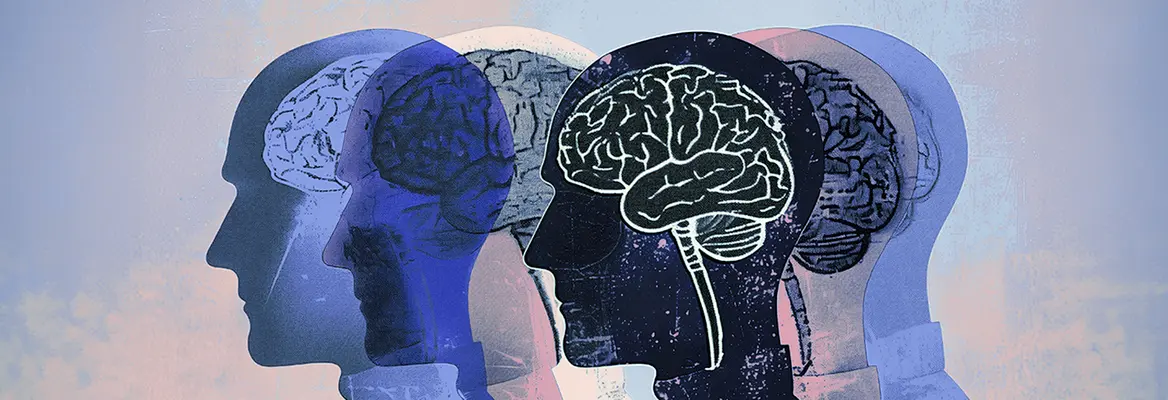

Forgetting is usually seen as a flaw in the human brain. But neuroscientist Oliver Hardt argues that forgetting is in fact crucial for some of the most important parts of our brain function. If you remembered every version of every face you'd ever seen, you wouldn't be able to recognize anyone. Your brain needs to erase the clutter to generalize and see patterns. Our capacity to forget isn’t a flaw of human memory, it’s an incredibly useful part of its design.
Every seven to thirty seconds, Clive Wearing appears in the here and now from nowhere, suddenly regaining consciousness out of nothingness. He cannot explain these extraordinary events, and so he records them in his diary immediately: “9:06 Now I am completely, overwhelmingly awake (for the first time).” But then he sees a previous line and reads “8:31 Now I am truly fully awake (for the first time)”—recognizing his handwriting, he realizes that he had just documented that very experience, but that is impossible because he has no memory of it, and he crosses out the earlier entry, as it must have been a mistake. So it goes, page after page.
When his wife Deborah visits him in his hospital room, he greets her effusively because he cannot remember when he last saw her—years might have passed. And when she leaves the room briefly and returns a few minutes later, this moving scene repeats itself with the same intensity as before, as Clive has no memory of it. Like the townspeople of Punxsutawney in Groundhog Day, he completely forgets everything he experiences, but the reset happens every waking minute of the day, not once every 24 hours.
Clive once worked at BBC Radio 3, played several instruments, and conducted an amateur choir, a renowned expert on early music, specializing in the Renaissance composer Orlando di Lasso. But in 1985, herpes simplex virus caused a brain inflammation that damaged several parts of his brain and completely destroyed the hippocampus. Since then, Clive has lived perpetually in a moment that is no longer than a minute, and, stripped of past and future, he requires permanent care.
Clive’s diary is like a desperate attempt to replicate the function of a failed hippocampus, which normally would continuously store what just happened and where. We are completely unaware of this, cannot consciously control it, yet it is this built-in logbook of experiences that details why we are where we are and what we have done before, so that we can make sense of our current situation, firmly linked to our past.
___
As essential oils concentrate what defines a scent, forgetting distills the gist of memories by removing what is irrelevant.
___
If no lasting memory is formed when we experience an event, it is as if it never happened. One cannot decide after an experience whether it may be important and should be remembered, because that only works if there is a memory in the first place. Therefore, the brain has no choice but to automatically, indiscriminately, and comprehensively record what just transpired—a promiscuous encoding device steadily logging the events of our lives.
This necessary strategy reliably locates us in space and time and ensures that we rarely fail to commit something important to memory. But it comes at a significant cost. After a short time, most of the remembered events have turned into outdated signposts to the past that are no longer relevant to explaining the present. Even more problematic, most of them detail trite everyday occurrences that are little more than mnemonic dead weight.
Want to continue reading?
Get unlimited access to insights from the world's leading thinkers.
Browse our subscription plans and subscribe to read more.
Already a subscriber? Log in
Love the iai?
Sign up to get exclusive access.

Related Posts:



Related Videos:



30th April 2026



Join the conversation
Kevin Rigley 5 May 2026
Forgetting: Erasure or Reweighting?
Oliver Hardt argues that forgetting is not a flaw but an essential feature of memory. He goes further, suggesting that the brain contains mechanisms that actively erase or remove memories in order to remain adaptive.
This is an important shift away from the idea that forgetting is simply passive decay. But the language of erasure risks overstating what is actually happening.
Hardt’s own examples reveal a more subtle process. When memory supports generalisation, what is lost is not the experience itself, but its precision. When behaviour updates, what changes is not the existence of the memory, but its influence. When emotional burden is reduced, the event remains, but its weight shifts.
In each case, the past is not deleted. It is reweighted.
The distinction matters. To describe forgetting as erasure suggests that the system removes information. To describe it as reweighting suggests that the system changes which information is allowed to guide perception and action.
The experimental evidence aligns more closely with the latter. Behaviour changes because prior associations lose salience, not because they are cleanly removed from the system.
In humans, this becomes clearer still. We do not delete memories in order to function. We reinterpret them. A painful experience may remain vividly accessible, yet no longer dominate behaviour once its meaning has changed. Therapeutic approaches such as cognitive behavioural therapy rely precisely on this capacity: not to erase the past, but to alter its authority.
So while Hardt is right to insist that forgetting is active and necessary, it may be more accurate to say:
Forgetting is not the deletion of memory, but the regulation of its influence.
The question is not simply what is lost, but what is allowed to matter.