


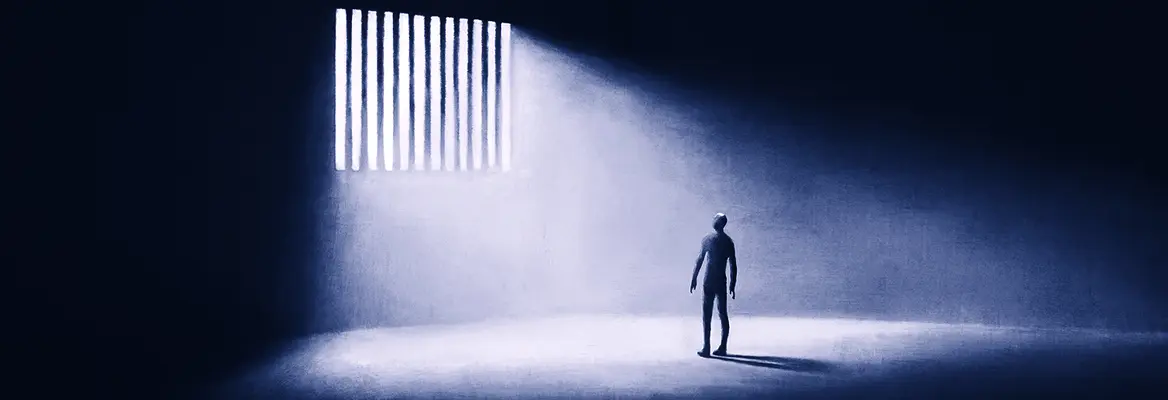

Incarceration is usually framed as the justified removal of freedom of movement. Federica Coppola, Associate Professor of Criminal Law at IE University Law School and author of The Real Pain of Punishment, argues this is a misidentification. Imprisonment is a form of manufactured exile, punishing not just the body's freedom but the self's very capacity to exist in relation to others. Against the Kantian notion that personhood is a self-contained bundle of autonomy, Coppola argues the deepest harm of imprisonment isn't the loss of liberty itself but the loss of belonging.
We tend to think of imprisonment primarily as the deprivation of liberty. That is, after all, what a prison sentence most obviously does: it takes away a person’s freedom to move, to choose where to live, whom to see, how to spend their time, and what to do with their own body. Because prison sentences are measured in months and years, it seems intuitive to assume that the longer a person is deprived of liberty, the greater the punishment. The loss of freedom is therefore understood as the defining pain of incarceration, and the duration of that loss as the measure of its severity—or so the theory goes.
Yet, when speaking with people who have experienced imprisonment firsthand, I have often been struck by how rarely they identify the loss of freedom alone as the most painful aspect of incarceration. What emerges far more often is the profound distress of feeling persistently invisible. This invisibility arises not only from physical confinement in places removed from the public eye. It is also produced through structural dynamics of misrecognition, powerlessness, and distrust that often shape life in prison. Under these conditions, personal histories, past traumas, and emotional needs recede behind the imperatives of risk management and control, while people’s voices may go unheard, their accounts of suffering disbelieved, and their needs left unmet.
 SUGGESTED VIEWING
How to philosophize behind bars
With Andy West
SUGGESTED VIEWING
How to philosophize behind bars
With Andy West
For many people, especially those who have spent long periods in prison, invisibility is intertwined with an enduring sense of isolation. Isolation here not only includes physical separation from society, but also the sense of abandonment, neglect, loneliness, helplessness, and hopelessness that comes with it. Separation from loved ones is central to many accounts. Yet its pain lies not only in being apart. It also lies in being unable to participate in and contribute to their lives—in knowing that children, partners, parents, or friends cannot rely on you when they need support. Imprisonment therefore deprives people not only of contact, but also of the ability to inhabit meaningful social roles: to care for others, support them, and matter in their lives.
Over time, these experiences can reshape how people understand themselves and their place in society. Being persistently unseen and unheard, and unable to sustain meaningful relationships, can erode a person’s identity, foster self-stigma, and diminish their sense of worth. Their individuality, growth, and capacity for change may go unrecognized, as may the intellectual, social, and other contributions they could still make to society.
Want to continue reading?
Get unlimited access to insights from the world's leading thinkers.
Browse our subscription plans and subscribe to read more.
Already a subscriber? Log in
Love the iai?
Sign up to get exclusive access.

Related Posts:



Related Videos:



23rd September 2026

Join the conversation