


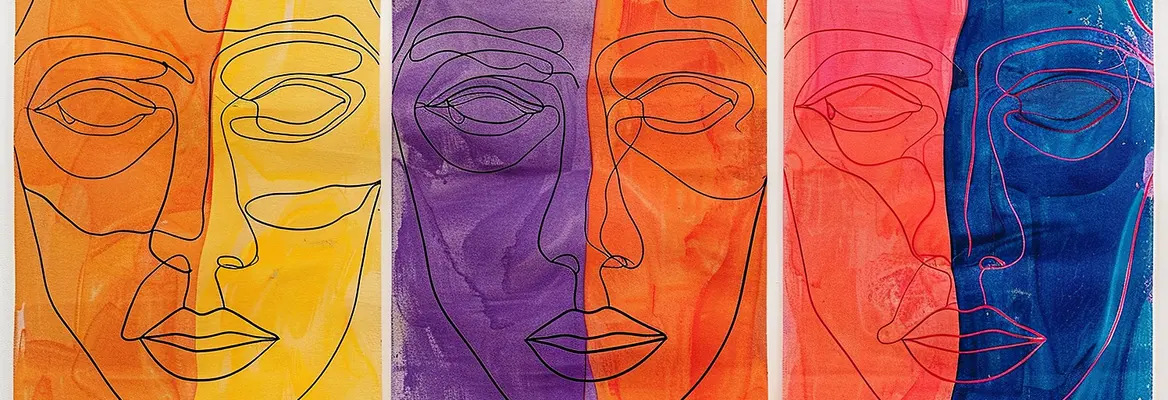

For centuries we’ve divided the world into tidy pairs: good and evil, male and female, gay and straight. But what if the need to draw such sharp lines tells us more about ourselves than about reality? Kevin Richardson, Associate Professor of Philosophy at Duke University, argues that the binary lens through which we view sex and gender — and many other domains — is a conceptual shortcut that distorts more than it clarifies. Rethinking these boundaries, he suggests, may be the first step toward understanding a world that was never meant to be simply divided in two.
“You can’t just be a little gay,” my friend Quinton said, shaking his head. “I don’t have anything against people who are, you know, gay. But let’s be real: you’re either gay or straight.”
This was the kind of conversation you only have with old friends. Quinton and I grew up in the same place: the Southern United States, in the church, surrounded by what we were taught were traditional values. We weren’t taught to hate anyone. But we were taught to believe that the world came neatly divided into two kinds of people. Two genders. Two sexual orientations. Male or female. Gay or straight.
___
What’s breaking down isn’t reality, but a way of constructing reality.
___
For Quinton, those lines in the sand are obvious and natural. Anything in between—bisexuality, pansexuality, non-binary gender—looks like confusion or deception. People, on this view, are really one thing or the other; the rest is just reluctance to admit it.
Our conversation had been sparked by something Quinton found troubling: Gen Z. Increasingly, young people don’t describe themselves as gay or straight at all. They identify as bisexual, pansexual, queer—or they avoid sexual orientation labels entirely. Alongside this shift in sexuality is a parallel shift in how people think about gender. Instead of identifying as male or female, many people now identify as non-binary—often meaning neither male nor female.
“I’m sorry,” Quinton said, “but the kids are confused.”
In my book, The End of Binaries, I argue that the kids aren’t confused at all. What’s breaking down isn’t reality, but a way of constructing reality—one that has always required enormous effort to maintain.
Binary thinking has a powerful grip on us because it feels simple, stable, and safe. If there are two genders and two sexual orientations, then social life is easier to navigate. We know what to expect. We know how to act. We know how to classify people.
On the traditional view many of us were raised with, sex, gender, and sexuality form a tight package. You’re born with certain physical characteristics—particularly reproductive anatomy—that determine your sex. Your sex determines your gender. Your gender determines your social role. And your sexual orientation is defined by which gender you’re attracted to.
This picture is often presented as a matter of biology, or even divine design. Nature made us this way. God intended it this way. To question the binary, on this view, is to deny reality itself.
___
Gender itself is not a pair of boxes into which people must be sorted. It is a multidimensional space structured by bodily traits, social roles, norms, and self-interpretations.
___
But this picture assumes something rarely made explicit: that gender and sexuality must be carved into discrete categories, rather than understood as continuous and multidimensional. That assumption is exactly what I challenge.
Want to continue reading?
Get unlimited access to insights from the world's leading thinkers.
Browse our subscription plans and subscribe to read more.
Already a subscriber? Log in
Love the iai?
Sign up to get exclusive access.

Related Posts:



Related Videos:

3rd March 2026

Join the conversation