


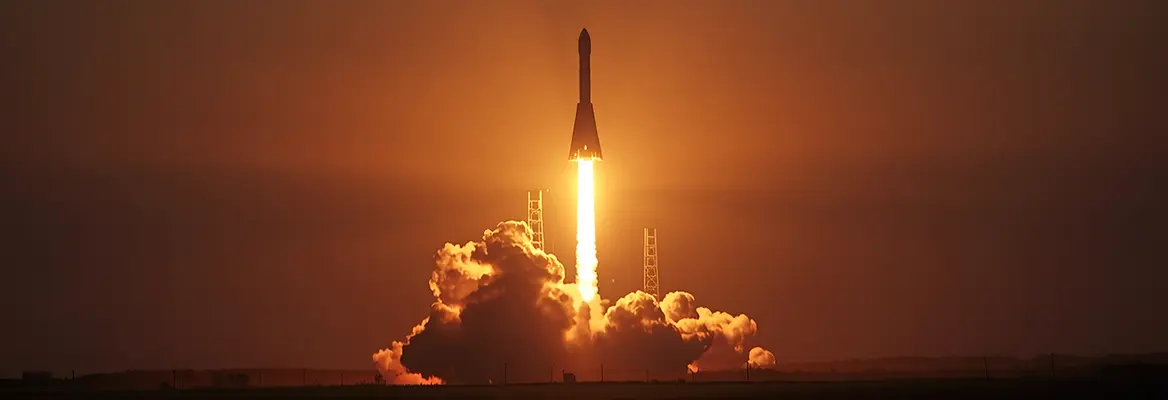

Following Artemis II, space as humanity's shared frontier is once again in the spotlight. And most nations purport to agree, space should be reserved for peace. In the build-up to HowTheLightGetsIn's debate this May, One Giant Conflict for Mankind, space security researcher Jessica West argues that "peace" has become so stretched as a concept that it now covers almost anything — including blowing up satellites. This ‘fog of peace’ is allowing military build-up in space and threatens to spread to the moon. This could have catastrophic consequences for life on Earth, if the satellites we rely on to detect missile launches and communicate in crises are disrupted.
“We came in peace for all mankind,” reads the plaque left on the Moon by Apollo 11 in 1969. In space, peace has long mattered as both aspiration and political language. It has helped legitimize exploration, cooperation, and free access. Yet over time, the idea of peaceful use has also stretched to accommodate not only military support functions but capabilities with clear weapons implications. That is the paradox. Space is supposed to be peaceful. But peace has too often remained a broad political concept rather than a substantive standard capable of setting limits.
Peace itself is not the problem. It remains a foundational principle of space activity, one that has helped give space its legitimacy and purpose. The problem is that peace has too rarely been translated into clear expectations, meaningful restraints, or judgments about which activities create unacceptable risks. In that sense, the weapons problem in space is not separate from the politics of peace. It has grown in the space between invoking peace and making it real.
That failure matters now more than ever. Space is no longer a distant dream or a symbolic arena of rivalry. It is woven into the ordinary functioning of modern life. Weather forecasting, video calls, financial timing, emergency response, navigation, air and maritime traffic, and key public infrastructure all depend on space-based systems. All of this depends on space remaining reliable, accessible, and secure. In other words, peaceful. But what happens when the idea of peace is too thin to distinguish between shared use and military advantage?
___
It is difficult to control weapons that few are willing to call weapons.
___
This tension was there from the beginning of the space age. From the Eisenhower era on, outer space was publicly framed in terms of peaceful purposes, even as military interests and capabilities shaped its development. Sputnik captured both at once: a symbol of human possibility and a reminder that the same rockets could carry weapons. What emerged was not simply hypocrisy, but a durable ambiguity. That ambiguity was soon embedded in governance as well. In 1958, the UN General Assembly affirmed the peaceful use of outer space and established COPUOS, making peace not only an aspiration, but an organizing principle of space governance.
So despite early promises, “peaceful” did not come to mean non-military. It came to mean something closer to not openly aggressive in space, even if activity in space directly supported armed conflict on Earth. Some military uses were not only tolerated but welcomed. Reconnaissance satellites, for example, helped reinforce arms control agreements and reduce the risk of surprise attack or misinterpretation. In that sense, space could be both peaceful and militarized. The difficulty is that this more permissive understanding of peace left unresolved where restraint should actually begin.
Want to continue reading?
Get unlimited access to insights from the world's leading thinkers.
Browse our subscription plans and subscribe to read more.
Already a subscriber? Log in
Love the iai?
Sign up to get exclusive access.

Related Posts:



Related Videos:




27th April 2026



Join the conversation