


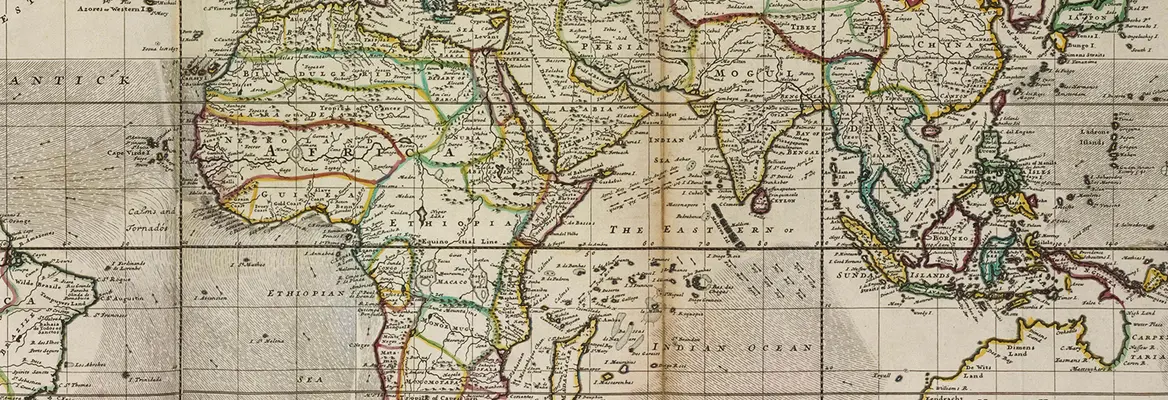

What counts as a "country" is far from an objective fact. In spite of measures such as borders, governments, and people, political scientist Ian Hurd argues that statehood is a fragile social fiction. From the UK’s sudden recognition of Palestine to Israel’s strategic deals in Africa, nations grant or withhold recognition not based on a territory's merit, but on cold strategic interest. Ultimately, international law is used as a tool to justify these political whims, and the desperate search for official status signals a state's fundamental vulnerability.
I often begin my class on International Politics by presenting a map of the world and asking students how many countries there are. Many offer 193 as the answer, which is a decent starting point: it is the membership of the United Nations. A few will then point out that Palestine, a country by most standards, has been kept out of the UN for political reasons, but may tick the number up by one. Others bring up Kosovo, or Taiwan, or Tibet, each a non-UN member with a plausible claim to statehood that might bring the number even higher. A few wonder whether Tuvalu (pop. 10,000) or Monaco (<1 sq mi.) should be taken seriously as countries, and if not, then the number should perhaps be smaller.
The conversation circles until we land somewhere that many find unsatisfactory: no one knows how to count the number of countries because no one knows what counts as a country. It isn’t a math question—it’s a window into the politics of recognition.
___
Recognition decisions typically have more to do with the interests of the government making the decision than they do with the objective features of the target.
___
Countries come into being when they are recognized by others—we call this practice diplomatic recognition. Recognition might refer to recognizing the state itself, or the government of the state, or of certain boundaries. The history of recognition is full of norms and rules and customs, and also of ambiguities and contradictions and oddities. The fact that recognition doesn’t follow well-behaved conventions makes it all the more interesting: it is a space of politics and history, not of consistency or patterns.
The common-sense view is that a country deserves recognition when it has a coherent government, a set of borders, and a population inside it. A distinct language and sense of culture help too. These are the criteria set out in an international agreement from 1933 called the Montevideo Convention, which helped to standardize the modern legal idea of statehood: a country is a thing that has territorial frontiers, a population, a government, and relations with others.
It is easy to see that the UK, Canada, and Tuvalu have these properties. But so too does my house: it has boundaries (property lines, plus a hedgerow for good measure), inhabitants who have relations with the neighbors, and a way of making household decisions. What makes countries unique as a political form is that they are recognized by others as countries. They are social facts rather than brute facts; their existence depends on what others say and do about them. This is where things get interesting.
Recognition decisions are made by governments according to their own desires and judgments. Neither Montevideo nor any other piece of international law obligates countries to recognize those who meet the criteria. Recognition decisions typically have more to do with the interests of the government making the decision than they do with the objective features of the target.
Want to continue reading?
Get unlimited access to insights from the world's leading thinkers.
Browse our subscription plans and subscribe to read more.
Already a subscriber? Log in
Love the iai?
Sign up to get exclusive access.

Related Posts:




Related Videos:



15th April 2026


Join the conversation
Themis Matsoukas 16 April 2026
Should I be shocked by the revelation that “country” is a legal term and as such subject to interpretation and dispute?