


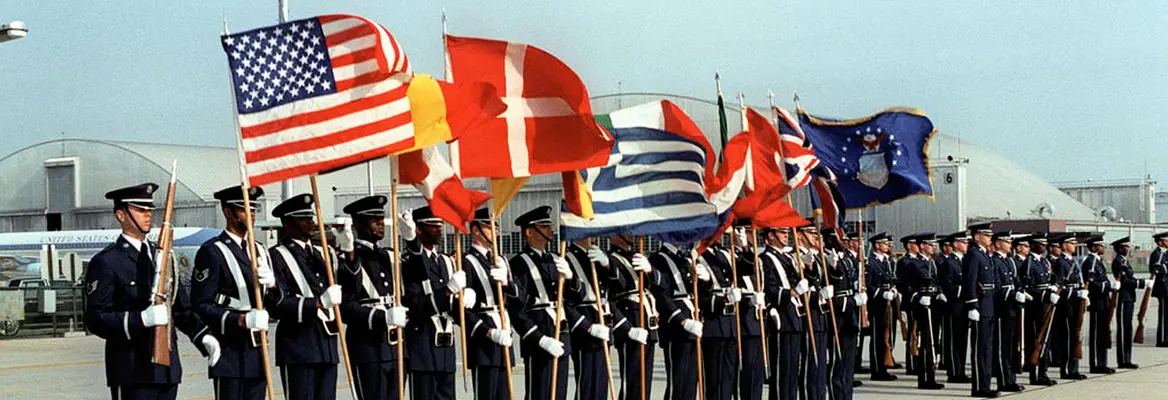

Most people assume Europe can't defend itself without the US – even NATO Secretary General Mark Rutte says those who think otherwise should "keep on dreaming." But this mindset, argues political scientist Rajan Menon, is the product of decades of American strategy that has convinced wealthy, capable NATO allies they are powerless without Washington. In fact, Europe possesses the resources and capabilities to defend itself. Menon shows how Europe's chosen dependence could be overcome, and why the Trump era makes it both possible and necessary.
States see their security as tied to the domination of other states—or at least the powerful ones do. But that doesn’t necessarily require occupation and conquest; security through domination can be achieved subtly, and even with the consent of weaker states. NATO’s evolution since its founding in 1949 is an example of what might be called silk-glove hegemony.
The United States turned its European allies into dependencies, who soon could not conceive of security apart from an alliance with Washington. And as long as they believed that Washington’s protection was indispensable, the US acquired leverage that could be used in many ways—not only matters of war and peace. The problem for the dependencies is that when the hegemon radically changes the terms of the bargain, they are caught flat-footed. They have lost the capacity to conceive of security outside the established arrangement and also lack experience in acting in concert to make their way toward a new one. This, as NATO’s history shows, is precisely the predicament that America’s allies now face.
The alliance in a post-Cold War world
During the Cold War, NATO’s purpose was captured by invoking Lord Ismay, the alliance’s first Secretary-General, who quipped that it existed to “keep the Americans in, the Russians out, and the Germans down.” The formulation was memorable because it distilled the alliance’s strategic logic: deter Soviet expansion, anchor American power in Europe, and prevent the reemergence of destabilizing German militarism.
By 1989, however, two pillars of that rationale had eroded. Communist regimes collapsed across East-Central Europe, ending the Warsaw Pact. In 1991, the Soviet Union itself dissolved. What did it mean any longer to say that one of NATO’s purposes was to ward off a Russian threat? Yes, the Russian Federation that emerged was nuclear-armed, but it was economically devastated, its GDP contracting by roughly 40% during the 1990s.
As for Germany, by the late 1980s, Europe’s fear of Berlin’s revanchism had faded. A democratic Germany had integrated into European institutions and bore no resemblance to its past. The argument that NATO was needed to “keep Germany down” was no longer persuasive.
___
Rutte’s recent claim that Europe cannot defend itself independently beggars belief, but it reflects a belief widely held by European leaders and defense experts, who seem incapable of imagining a security strategy that does not involve perpetual dependence on the United States.
___
Despite all of these changes, NATO did not fade away. A generation of British, European and Canadian leaders internalized a grand strategy centered on American leadership that institutional ties, military cooperation, think tanks, universities, and assorted elite networks reinforced. While their reasons differed, both they and the United States sought to reshape NATO, not defenestrate it.
Both the expansion of the alliance’s membership and the ensuring of Europe’s continuing dependence on Washington aimed to guarantee NATO’s continued relevance amidst dramatically different circumstances. Beginning in the 1990s, NATO admitted, in stages, former Warsaw Pact members and one-time Soviet republics. Russia objected repeatedly, but to no avail. Today, NATO has 32 members, preserving America’s leadership role within Europe.
Want to continue reading?
Get unlimited access to insights from the world's leading thinkers.
Browse our subscription plans and subscribe to read more.
Already a subscriber? Log in
Love the iai?
Sign up to get exclusive access.

Related Posts:



Related Videos:


4th March 2026



Join the conversation